






 Support our online development, and advance our onground research initiatives in free market economics, as we seek to showcase the brightest Next-Gen minds.
THE ME-P DISCLAIMER: Posts, comments and opinions do not necessarily represent iMBA, Inc., but become our property after submission. Copyright © 2006 to-date. iMBA, Inc allows colleges, universities, medical and financial professionals and related clinics, hospitals and non-profit healthcare organizations to distribute our proprietary essays, photos, videos, audios and other documents; etc. However, please review copyright and usage information for each individual asset before submission to us, and/or placement on your publication or web site. Attestation references, citations and/or back-links are required. All other assets are property of the individual copyright holder.
Support our online development, and advance our onground research initiatives in free market economics, as we seek to showcase the brightest Next-Gen minds.
THE ME-P DISCLAIMER: Posts, comments and opinions do not necessarily represent iMBA, Inc., but become our property after submission. Copyright © 2006 to-date. iMBA, Inc allows colleges, universities, medical and financial professionals and related clinics, hospitals and non-profit healthcare organizations to distribute our proprietary essays, photos, videos, audios and other documents; etc. However, please review copyright and usage information for each individual asset before submission to us, and/or placement on your publication or web site. Attestation references, citations and/or back-links are required. All other assets are property of the individual copyright holder.


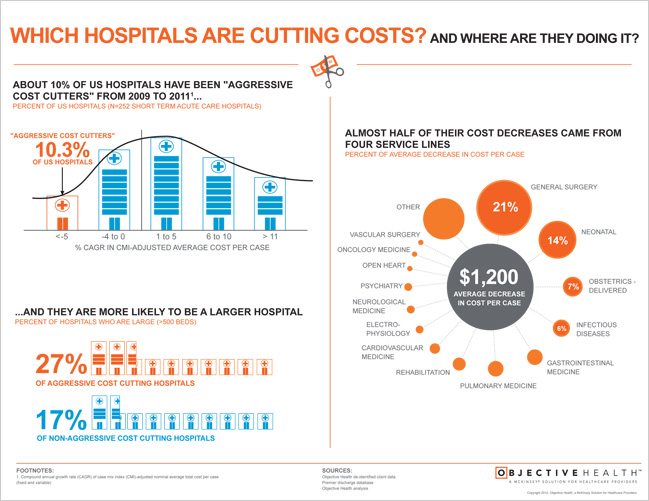
And … Where Are They Doing It?
This infographic shows that about only 10% of US hospitals have aggressively cut costs during the recession. Most hospitals have kept costs close to inflation with 1-5% annual increases.
Of those who aggressively cut costs, many service lines contributed, though general surgery was the largest, followed by neonatal, obstetrics, and infectious diseases.
Conclusion
Your thoughts and comments on this ME-P are appreciated. Feel free to review our top-left column, and top-right sidebar materials, links, URLs and related websites, too. Then, subscribe to the ME-P. It is fast, free and secure.
Speaker: If you need a moderator or speaker for an upcoming event, Dr. David E. Marcinko; MBA – Publisher-in-Chief of the Medical Executive-Post – is available for seminar or speaking engagements. Contact: MarcinkoAdvisors@msn.com
OUR OTHER PRINT BOOKS AND RELATED INFORMATION SOURCES:
- PRACTICES: www.BusinessofMedicalPractice.com
- HOSPITALS: http://www.crcpress.com/product/isbn/9781466558731
- CLINICS: http://www.crcpress.com/product/isbn/9781439879900
- ADVISORS: www.CertifiedMedicalPlanner.org
- FINANCE: Financial Planning for Physicians and Advisors
- INSURANCE: Risk Management and Insurance Strategies for Physicians and Advisors
- Dictionary of Health Economics and Finance
- Dictionary of Health Information Technology and Security
- Dictionary of Health Insurance and Managed Care


Share this:

Filed under: Health Economics | Tagged: hospital costs, hospital economics, hospital finance, Which Hospitals Are Cutting Costs |
 The Leading Business Education Network for Doctors, Financial Advisors and Health Industry Consultants
3 reimbursement changes for hospital performance
Hospitals are bracing themselves for some significant reimbursement changes under health reform that could hit their pocketbooks.
For example, the American Hospital Association (AHA) outlined top issues in its 2012 advocacy papers, including how hospitals will be measured for performance this year and beyond.
http://www.fiercehealthcare.com/story/providers-have-mixed-feelings-cms-proposed-hospital-payments/2012-04-27?utm_medium=nl&utm_source=internal
Clyde
LikeLike
Yeah! But … Insurance Dictates Hospital Costs
http://healthcareisbusiness.blogspot.com/2012/04/do-math-insurance-dictates-hospital.html
Beverly
LikeLike
Hospitals lower prices for patients paying cash
Many hospitals and physicians are offering large discounts if patients pay in cash and don’t use their health insurance, the Los Angeles Times just reported.
For example, a CT scan of the abdomen costs about $2,400 for patients insured by Blue Shield of California, while the Los Alamitos (Calif.) Medical Center cash price is only $250, according to the article.
Another local California hospital charges insured patients $415 for blood tests that cost only $95 in cash.
http://www.latimes.com/business/la-fi-medical-prices-20120527,0,4627745.story
Cash is most always … king!
Magellan
LikeLike
Hospital Costs – Historical Review
Here is an interesting essay – “Two Hundred Years of Hospital Costs and Mortality — MGH and Four Eras of Value in Medicine”.
http://www.nejm.org/doi/full/10.1056/NEJMp1202628?query=TOC
Enjoy all you been counters.
Dr. Jamison
LikeLike
Safe Hospitals
But, where are the safe hospitals?
http://vitals.msnbc.msn.com/_news/2012/06/19/12298302-massachusetts-maine-have-safest-hospitals-in-us?lite
Etian
LikeLike
No silver bullet for cost-saving measures in healthcare
http://www.physbiztech.com/news/no-silver-bullet-cost-saving-measures-healthcare
Ya think?
Xena
LikeLike
The Transition to Outpatient of Coronary Angioplasty (PTCA)
This infographic shows an example of how US hospitals are lowering the cost of care by transitioning procedures that have traditionally been inpatient admissions into the outpatient setting.
Payors (including Medicare, employers, and the general public) are benefiting from much of the savings that have been created. Being on the leading edge of this transition is especially critical for hospitals looking to position themselves as cost efficient health care providers.
Laura Padden
Media relations for McKesson Health Solutions
TECHMarket Communications
(818) 597-0480
LikeLike
PRICES
With rare exceptions hospitals cannot and will not tell anyone their prices in advance of admission; but they may tell you their charges. Fortunately, market forces may be coming to the rescue.
Why?
As more consumers enroll in health plans with high deductibles and large copayments, there is demand for information about actual prices. And, where there is demand, supply usually follows.
Some private insurers are beginning to post pricing comparisons on their websites, allowing consumers to determine which hospital is likely to offer lower out-of-pocket costs. Insurers are naturally reluctant to disclose the actual amounts they have contracted to pay hospitals, so this information is somewhat nebulous.
Bernard
LikeLike