





 Support our online development, and advance our onground research initiatives in free market economics, as we seek to showcase the brightest Next-Gen minds.
THE ME-P DISCLAIMER: Posts, comments and opinions do not necessarily represent iMBA, Inc., but become our property after submission. Copyright © 2006 to-date. iMBA, Inc allows colleges, universities, medical and financial professionals and related clinics, hospitals and non-profit healthcare organizations to distribute our proprietary essays, photos, videos, audios and other documents; etc. However, please review copyright and usage information for each individual asset before submission to us, and/or placement on your publication or web site. Attestation references, citations and/or back-links are required. All other assets are property of the individual copyright holder.
Support our online development, and advance our onground research initiatives in free market economics, as we seek to showcase the brightest Next-Gen minds.
THE ME-P DISCLAIMER: Posts, comments and opinions do not necessarily represent iMBA, Inc., but become our property after submission. Copyright © 2006 to-date. iMBA, Inc allows colleges, universities, medical and financial professionals and related clinics, hospitals and non-profit healthcare organizations to distribute our proprietary essays, photos, videos, audios and other documents; etc. However, please review copyright and usage information for each individual asset before submission to us, and/or placement on your publication or web site. Attestation references, citations and/or back-links are required. All other assets are property of the individual copyright holder.


A New Policy Resource For Hospitals and Doctors
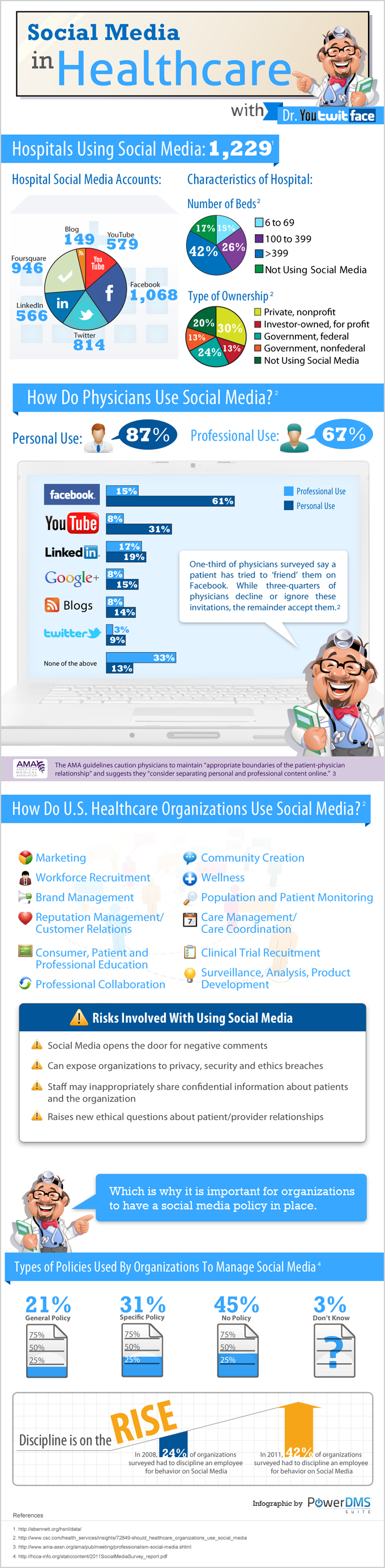
Social media is becoming increasingly more prevalent within the healthcare industry. With more hospitals and doctors joining social-media platforms on a consistent basis, it begs the question of “helpful or harmful”? One thing is certain: clear parameters must be established, so professional and personal lines don’t become blurred.
It’s vital to have a well-diversified and comprehensive social-media policy in place, outlining the dos and don’ts for everyone within your facility.
So, start reducing risk and liability associated with social media, stat—access renowned medical facilities’ social media policies for their guidelines on getting social.
Conclusion
Your thoughts and comments on this ME-P are appreciated. Feel free to review our top-left column, and top-right sidebar materials, links, URLs and related websites, too. Then, subscribe to the ME-P. It is fast, free and secure.
Speaker: If you need a moderator or speaker for an upcoming event, Dr. David E. Marcinko; MBA – Publisher-in-Chief of the Medical Executive-Post – is available for seminar or speaking engagements. Contact: MarcinkoAdvisors@msn.com
OUR OTHER PRINT BOOKS AND RELATED INFORMATION SOURCES:
- DICTIONARIES: http://www.springerpub.com/Search/marcinko
- PHYSICIANS: www.MedicalBusinessAdvisors.com
- PRACTICES: www.BusinessofMedicalPractice.com
- HOSPITALS: http://www.crcpress.com/product/isbn/9781466558731
- CLINICS: http://www.crcpress.com/product/isbn/9781439879900
- ADVISORS: www.CertifiedMedicalPlanner.org
- BLOG: www.MedicalExecutivePost.com
- FINANCE:Financial Planning for Physicians and Advisors
- INSURANCE:Risk Management and Insurance Strategies for Physicians and Advisors



Share this:

Filed under: Health Law & Policy, Information Technology | Tagged: social media for doctors, social media for hospitals, Social Media in Healthcare, social media policy for doctors, social media policy for hospitals, social media policy for physicians |


My Reasons SMS Is Unacceptable for Critical Hospital Communications
Many hospitals are using SMS or email for critical messaging today. This means critical physician consult requests are mixed into the same inbox as a simple hello from a friend.
So, here are three reasons why this is a risky proposition, especially when compared to smartphone application messaging options available today.
• Messages sent via SMS lack security and encryption
• SMS cannot show full traceability or escalations
• SMS cannot ensure priority delivery of messages
Can you think of some others?
Richard
LikeLike
Pulitzer Prizes announced; online journalism gets noticed
According to Isolde Raftery, of msnbc.com, the Pulitzer Prizes board just gave a nod to the increasingly online medium of journalism as it announced its 2012 awards, noting online components to print stories.
Surprise winners included the Huffington Post, for national reporting; the Stranger, an alternative weekly in Seattle, for feature reporting; and the online site POLITICO, for editorial cartoon.
http://usnews.msnbc.msn.com/_news/2012/04/16/11230986-pulitzer-prizes-announced-online-journalism-gets-noticed?lite
So, social media is indeed maturing. Who knows, the ME-P may be a winner, someday!
Deserie
LikeLike
Why social media may not be worth it for doctors
Social media in healthcare is all the rage these days. You can’t visit even one physician-oriented website without someone breathlessly advising you to be on Twitter, Facebook, LinkedIn, YouTube and now Pinterest.
Yet the only reason these talking heads can give you is, “because they are really popular and everyone is doing it.” And, Social media consulting is a bubble economy at the moment.
http://www.kevinmd.com/blog/2012/04/social-media-worth-doctors.html
But, don’t listen to them all.
Patel Alpa
LikeLike
Patel,
Many thanks for another POV.
Gregory
LikeLike
For Doctor Bloggers
http://www.entrepreneurialmd.com/index/2012/10/19/for-physician-bloggers-a-handy-guide-to-getting-your-word-ou.html
Review this handy guide to getting your e-word out.
Ann Miller RN MHA
LikeLike
Docs and Dentists Lure Patients with Online Deals?
Did you know that health and medical deals make up about 5 to 10 percent of the online coupon industry.
Yep; Groupon, the market leader, had about 115 million subscribers in 2011, which he says are mostly 20- to 40-year-old college-educated women. Living Social says it has about 70 million members.
http://www.physiciansnews.com/2013/01/09/docs-and-dentists-lure-patients-with-online-deals/
And, although health providers often see good results after an initial offer, but the patients who come in for treatment frequently don’t return. Any thoughts?
Ann Miller RN MHA
LikeLike
Healthcare social media
Listen up, medical providers – Here’s why social media matters to physicians, and what you can do to get engaged in this evolving communications medium.
http://www.medicalpracticeinsider.com/best-practices/healthcare-social-media-listen-medical-providers-0?email=MARCINKOADVISORS@MSN.COM&GroupID=116654
Ann Miller RN MHA
LikeLike
Examples of Social Media in Healthcare
More than ever, it’s essential for hospitals and health providers to rethink their healthcare marketing mix to include social media.
http://www.toprankblog.com/2010/01/social-media-healthcare-marketing/
Kent
LikeLike
The Supreme Court and social media
[Implications for physicians]
Social media and the Internet have often been compared to the Wild West at times when it comes to the posting of ideas, opinions and beliefs. There has been very little regulation of what is posted and how it is utilized — which may actually be a good thing.
http://www.kevinmd.com/blog/2014/12/supreme-court-social-media-implications-physicians.html
However, many of us have learned (often the hard way) that posts on Facebook, Twitter or other social media sites can be taken out of context and misinterpreted by the masses whom the information may not have been intended for.
Dr. Shopley
LikeLike
The Supreme Court and social media
[Implications for physicians]
Social media and the Internet have often been compared to the Wild West at times when it comes to the posting of ideas, opinions and beliefs.
http://www.kevinmd.com/blog/2014/12/supreme-court-social-media-implications-physicians.html
There has been very little regulation of what is posted and how it is utilized — which may actually be a good thing.
Ann Miller RN MHA
LikeLike