





 Support our online development, and advance our onground research initiatives in free market economics, as we seek to showcase the brightest Next-Gen minds.
THE ME-P DISCLAIMER: Posts, comments and opinions do not necessarily represent iMBA, Inc., but become our property after submission. Copyright © 2006 to-date. iMBA, Inc allows colleges, universities, medical and financial professionals and related clinics, hospitals and non-profit healthcare organizations to distribute our proprietary essays, photos, videos, audios and other documents; etc. However, please review copyright and usage information for each individual asset before submission to us, and/or placement on your publication or web site. Attestation references, citations and/or back-links are required. All other assets are property of the individual copyright holder.
Support our online development, and advance our onground research initiatives in free market economics, as we seek to showcase the brightest Next-Gen minds.
THE ME-P DISCLAIMER: Posts, comments and opinions do not necessarily represent iMBA, Inc., but become our property after submission. Copyright © 2006 to-date. iMBA, Inc allows colleges, universities, medical and financial professionals and related clinics, hospitals and non-profit healthcare organizations to distribute our proprietary essays, photos, videos, audios and other documents; etc. However, please review copyright and usage information for each individual asset before submission to us, and/or placement on your publication or web site. Attestation references, citations and/or back-links are required. All other assets are property of the individual copyright holder.


On Perceptions of the Physician’s Ability to Communicate

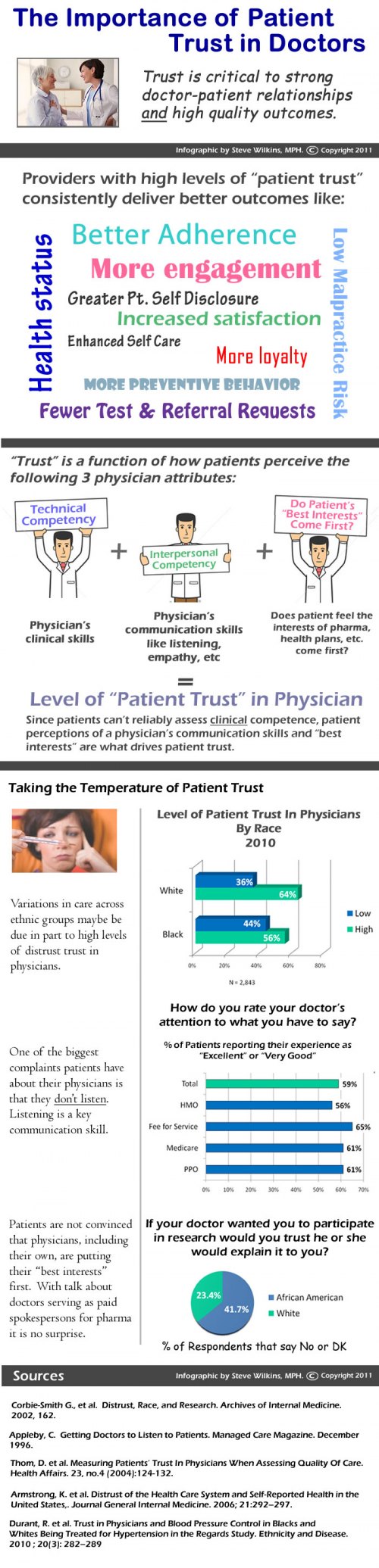
Often the simplest solutions to problems are the best; remember KISS. So it would seem that when it comes to the impact of increasing patient trust in physicians – on many of the intractable challenges that face the health care industry everyday like nonadherence, lack of involvement, poor health status, dissatisfaction etc – the concept of trust is great, indeed!
Assessment
We explore the link between patient trust and outcomes in the infographic above, which Stephen Wilkins curated and designed. What surprised us however, is how a patient’s level of trust in their doctor, boils downs to the patient’s perception of the physician’s ability to communicate.
Source: Stephen Wilkins, MPH http://healthecommunications.wordpress.com/about/
Conclusion
And so, your thoughts and comments on this ME-P are appreciated. Feel free to review our top-left column, and top-right sidebar materials, links, URLs and related websites, too. Then, subscribe to the ME-P. It is fast, free and secure.
Link: http://feeds.feedburner.com/HealthcareFinancialsthePostForcxos
Speaker: If you need a moderator or speaker for an upcoming event, Dr. David E. Marcinko; MBA – Publisher-in-Chief of the Medical Executive-Post – is available for seminar or speaking engagements. Contact: MarcinkoAdvisors@msn.com
Our Other Print Books and Related Information Sources:
Health Dictionary Series: http://www.springerpub.com/Search/marcinko
Practice Management: http://www.springerpub.com/product/9780826105752
Physician Financial Planning: http://www.jbpub.com/catalog/0763745790
Medical Risk Management: http://www.jbpub.com/catalog/9780763733421
Healthcare Organizations: www.HealthcareFinancials.com
Physician Advisors: www.CertifiedMedicalPlanner.com
Subscribe Now: Did you like this Medical Executive-Post, or find it helpful, interesting and informative? Want to get the latest ME-Ps delivered to your email box each morning? Just subscribe using the link below. You can unsubscribe at any time. Security is assured.
Link: http://feeds.feedburner.com/HealthcareFinancialsthePostForcxos
Sponsors Welcomed: And, credible sponsors and like-minded advertisers are always welcomed.
Link: https://healthcarefinancials.wordpress.com/2007/11/11/advertise



Share this:

Filed under: "Doctors Only", Career Development, Ethics | Tagged: collaborative medicine, health 2.0, http://healthecommunications.wordpress.com/about/, patient centered care, Patient Trust, Sephen Wilkins |
 The Leading Business Education Network for Doctors, Financial Advisors and Health Industry Consultants
Insurers’ Earnings Show Americans Still Using Less Medical Care
Since signs emerged last year that Americans were using fewer medical services, the question has been when we would flock back to clinics and hospitals. The answer: not yet.
With four big insurers already done announcing earnings, there are scant signs of an uptick in “utilization.”
http://blogs.wsj.com/health/2011/10/28/insurers-earnings-show-americans-still-using-less-medical-care
Barbara
LikeLike
More on Patient Trust
I trust my family physician implicitly. I do not doubt his technical competency or his personal integrity in putting me first. But, a recent visit to him confirmed the interpersonal competency deficit, the third ingredient required for trust that is mentioned here. I now realize that the “Patient Trust” level took a hit. This communication gap was highlighted at the visit in an unusual way.
At the beginning of the visit my doctor greets me in the exam room and asks if it would be ok if I was seen instead by a medical student who was in his third-year clerkship in family medicine. My doctor assured me that he would supervise the outcome. I agreed, and in walks a smiling young twenty something year old eager to help. It was just written all over his face: “How can I help you?”! The doctor leaves us two alone in the exam room. I was having repeated migraines and was looking for relief. Rather than take my self-diagnosis at face value as my good doctor had in a prior visit, the young medical student proceeds to ask a litany of questions, interspersed with explanations as he engaged me as part of the diagnosis process. As it turns out, I wasn’t having migraines at all, but rather tension headaches caused by my stiff neck due to a past accident. The medication I needed was not to relieve my “migraine” headaches, but rather to relieve the stiffness in my neck causing the headaches. With the new medication my headache frequency diminished greatly. The young doc-to-be became my hero! And, to think that I almost became annoyed 10 minutes into his questions!
Experience makes us lazy sometimes. As experienced physicians and as experienced financial advisors we often think we know the answer in the first couple of minutes when dealing with a patient or client. We’ve seen it all before hundreds of times.
However, as my personal experience with the third year medical student shows, going back to basics, asking questions, listening, and holding off any diagnosis or solution until all the facts are gathered is good best practice. My Mom once told me: “God gave you two holes to listen and one hole to speak. Use them accordingly!”
We could all benefit from that advice.
David K. Luke MIM
http://www.networthadvice.com
LikeLike
About the series “Who Protects the Patients”
[Trust – What Trust?]
A Post-Dispatch investigation this year has shown how patients are kept in the dark about problems with their doctors and hospitals, and how a disciplinary system seems geared toward protecting doctors’ livelihoods.
http://www.stltoday.com/collection_80f00aea-0657-11e0-9e15-00127992bc8b.html
Milton
LikeLike
Demonizing The Demonization Of Physician-Industry Relationships
To restore physicians to their baseline state of virginal professional purity and trust, the Physician’s Payment Sunshine Act mandates a stultifying series of reporting requirements, impacting amounts as little as $10.
And, while such reports may be a Pharmascold’s wet dream, they are a logistical nightmare for the physicians involved, and serve to create an enormous compliance bureaucracy for everyone.
http://thehealthcareblog.com/blog/2012/01/27/demonizing-the-demonization-of-physician-industry-relationships/
Gary
LikeLike