





 Support our online development, and advance our onground research initiatives in free market economics, as we seek to showcase the brightest Next-Gen minds.
THE ME-P DISCLAIMER: Posts, comments and opinions do not necessarily represent iMBA, Inc., but become our property after submission. Copyright © 2006 to-date. iMBA, Inc allows colleges, universities, medical and financial professionals and related clinics, hospitals and non-profit healthcare organizations to distribute our proprietary essays, photos, videos, audios and other documents; etc. However, please review copyright and usage information for each individual asset before submission to us, and/or placement on your publication or web site. Attestation references, citations and/or back-links are required. All other assets are property of the individual copyright holder.
Support our online development, and advance our onground research initiatives in free market economics, as we seek to showcase the brightest Next-Gen minds.
THE ME-P DISCLAIMER: Posts, comments and opinions do not necessarily represent iMBA, Inc., but become our property after submission. Copyright © 2006 to-date. iMBA, Inc allows colleges, universities, medical and financial professionals and related clinics, hospitals and non-profit healthcare organizations to distribute our proprietary essays, photos, videos, audios and other documents; etc. However, please review copyright and usage information for each individual asset before submission to us, and/or placement on your publication or web site. Attestation references, citations and/or back-links are required. All other assets are property of the individual copyright holder.


What it is – AND – How it Works?

Costs of Care, a nonprofit 501(c)(3), is a social venture that helps doctors understand how the decisions they make impact what patients pay for care.
By harnessing social media, mobile applications, and other information technologies, they give doctors and patients the information needed to deflate medical bills.
Health Economics Factoid
“The cost of health care now causes a bankruptcy in America every thirty seconds.”
(President Obama to the 2009 Joint Session of Congress)
Essay Contest
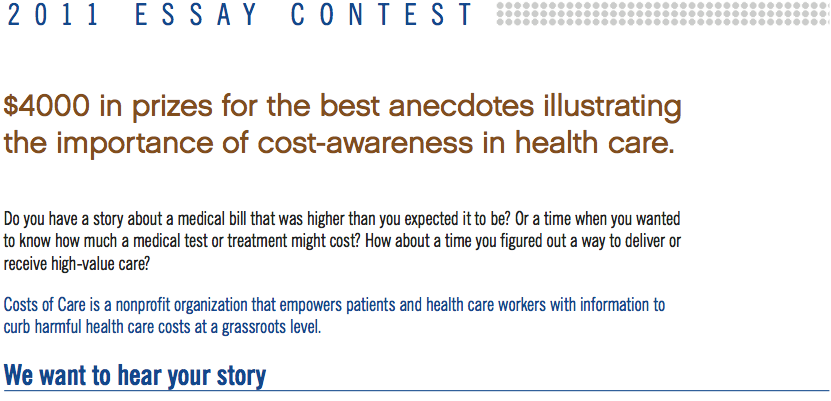
Costs of Care will be launching an essay contest for 2011 after Labor Day, with $4,000 in prizes for the best anecdotes illustrating the importance of cost awareness in health care! www.costsofcare.org/essay
Assessment
And so, give em’ a click and tell us what you think http://www.costsofcare.org/ Better yet! Enter the essay contest and/or give a donation. It’s tax deductible.
Conclusion
Your thoughts and comments on this ME-P are appreciated. Feel free to review our top-left column, and top-right sidebar materials, links, URLs and related websites, too. Then, subscribe to the ME-P. It is fast, free and secure.
Speaker: If you need a moderator or speaker for an upcoming event, Dr. David E. Marcinko; MBA – Publisher-in-Chief of the Medical Executive-Post – is available for seminar or speaking engagements. Contact: MarcinkoAdvisors@msn.com
OUR OTHER PRINT BOOKS AND RELATED INFORMATION SOURCES:
- PRACTICES: www.BusinessofMedicalPractice.com
- HOSPITALS: http://www.crcpress.com/product/isbn/9781466558731
- CLINICS: http://www.crcpress.com/product/isbn/9781439879900
- ADVISORS: www.CertifiedMedicalPlanner.org
- FINANCE: Financial Planning for Physicians and Advisors
- INSURANCE: Risk Management and Insurance Strategies for Physicians and Advisors
- Dictionary of Health Economics and Finance
- Dictionary of Health Information Technology and Security
- Dictionary of Health Insurance and Managed Care



Share this:

Filed under: Health Insurance, Healthcare Finance | Tagged: healthcare costs, medical cost cotainment, www.CostsofCare.org |
 The Leading Business Education Network for Doctors, Financial Advisors and Health Industry Consultants
Negotiating with your Physician
A video on tips for haggling with doctors:
http://www.msnbc.msn.com/id/21134540/vp/44466215#44466215?from=en-us_msnhp>1=43001
Clare
LikeLike
Controlling Costs Must Become Part of Resident Training
There are six things that young doctors need to learn during their training period as interns and residents, starting with basics like acquiring “medical knowledge” and honing their “patient care” skills.
The Accreditation Council for Graduate Medical Education and the American Board of Medical Specialties make sure that doctors-in-training master these general competencies before they complete their residency training.
http://www.massmed.org/Content/NavigationMenu2/ContinuingEducationEvents/CMEResources/ACGMECompetencies/ACGME_Competencies.htm
One more item should be added to this list, according to Dr. Steven E. Weinberger, chief executive of the American College of Physicians: how to provide high-quality medical care without breaking the bank.
• http://www.annals.org/content/155/6/386.abstract
• http://www.latimes.com/health/boostershots/la-heb-health-care-costs-residents-20110919,0,5453286.story
Hope R. Hetico RN MHA
[Managing Editor]
LikeLike
The Health Care Cost Institute [HCCI]
The HCCI was established to analyze health insurance claims data with the goal of finding new ways to cut costs.
http://healthcostinstitute.org
As health insurance companies seek to adopt measures that will reduce costs, the Health Care Cost Institute (HCCI) has been established to analyze data from more than 5 billion medical claim records representing more than $1 trillion of healthcare activity from calendar year 2000 to the present.
Maxwell
LikeLike
The Top Five [Top] 5 Unnecessary Healthcare Costs
Doctors’ prescribing a brand-name statin, without first checking to see if a lower-priced generic drug would cut a patient’s cholesterol sufficiently, results in $5.8 billion in excess health-care spending, according to a research letter published October 1st, 2011 by the Archives of Internal Medicine.
Other expensive practices deemed inappropriate by the authors: bone density scans for women ages 40 to 64 years, costing $527.4 million; ordering CT Scans or MRI’s for lower back pain, amounting to $175.4 million; and prescribing antibiotics to children with sore throats caused by a virus, worth $116.3 million.
http://archinte.ama-assn.org/cgi/content/full/archinternmed.2011.501
Plus One [+1] More from Me
And, to this list I would add the [over] treatment of plantar fasciitis and heel spur syndrome in runners, obese patients, and most others. Moreover, there is at least one medical blogger that agrees with me on this issue, as well.
Dr. David Edward Marcinko MBA CMP™
http://www.BusinessofMedicalPractice.com
LikeLike
Teaching Residents about Costs: The Price is Right
It all started while out to dinner with a couple of my fellow Brigham/Massachusetts General Hospital OB/Gyn residents. We were discussing our favorite old TV shows and one fellow resident’s love of The Price Is Right with Bob Barker.
After talking about the game show, a light bulb went off in my head and I thought, “Why can’t we play The Price is Right with hospital charges to our patients?”
A nice touchy-feely essay; but not an original thought by any means!
http://thehealthcareblog.com/blog/2012/01/03/teaching-residents-about-costs-the-price-is-right/
Doc to Patient: Dammit, I’m an MD; not a CPA
Patient to Doc: OK, then I’ll see the CPA / MD
Franz
LikeLike
Cost-Effectiveness and Medical Care
Franz – NPR reports a major medical group just issued ethical guidelines that take the provocative position of urging doctors to consider cost-effectiveness when deciding how to treat their patients.
The American College of Physicians, the second-largest U.S. doctors’ group after the American Medical Association, included the recommendation in the latest version of its ethics manual, which provides guidance for some 132,000 internists nationwide.
http://www.npr.org/blogs/health/2011/12/30/144485098/should-doctors-be-parsimonious-about-health-care
Bentley
LikeLike
More on the American College of Physicians and Costs
Bentley – While some experts estimate that excessive testing accounts for as much as 10 percent of the nation’s spiraling healthcare costs, the ACP’s most recent ethics manual recommends that physicians take a more “parsimonious” approach to deciding how to treat their patients in general.
http://yourlife.usatoday.com/health/healthcare/studies/story/2011-12-30/Overuse-of-diagnostic-exams-can-harm-patient-health/52284494/1
And, excessive diagnostic tests may be harmful.
Dr. Carter
LikeLike
Providers Devise New Fees To Levy Against Patients
Challenged by insurers ratcheting down their payments, hospitals and medical groups are creating more fees and charges for patients to pay as part of the care they receive, The New York Times reported.
William Rusteberg
LikeLike
Discounters
Discount dentistry brokers like Delta Dental (which erroneously calls itself a “dental insurance company”), used to encourage dentists to sign up by encouraging them to charge Delta clients their usual fees for procedures not covered by the plan.
However, in the last few years, Delta took that profit source away from its preferred providers as well. Even though Delta does not cover cosmetic dentistry, the broker discounts the amount their contracted dentists can charge naive Delta clients for not-covered procedures by about 30%. Happy, but clueless Delta clients aren’t told that 30% is almost all the profit in most dental practices (unless their Delta dentist quietly cuts corners in care).
Rushed dentistry is no bargain.
D. Kellus Pruitt DDS
LikeLike
Medical Bankruptcy?
https://www.kevinmd.com/blog/2018/10/medical-bankruptcies-happen-less-frequently-than-you-think.html
Candi
LikeLike