





 Support our online development, and advance our onground research initiatives in free market economics, as we seek to showcase the brightest Next-Gen minds.
THE ME-P DISCLAIMER: Posts, comments and opinions do not necessarily represent iMBA, Inc., but become our property after submission. Copyright © 2006 to-date. iMBA, Inc allows colleges, universities, medical and financial professionals and related clinics, hospitals and non-profit healthcare organizations to distribute our proprietary essays, photos, videos, audios and other documents; etc. However, please review copyright and usage information for each individual asset before submission to us, and/or placement on your publication or web site. Attestation references, citations and/or back-links are required. All other assets are property of the individual copyright holder.
Support our online development, and advance our onground research initiatives in free market economics, as we seek to showcase the brightest Next-Gen minds.
THE ME-P DISCLAIMER: Posts, comments and opinions do not necessarily represent iMBA, Inc., but become our property after submission. Copyright © 2006 to-date. iMBA, Inc allows colleges, universities, medical and financial professionals and related clinics, hospitals and non-profit healthcare organizations to distribute our proprietary essays, photos, videos, audios and other documents; etc. However, please review copyright and usage information for each individual asset before submission to us, and/or placement on your publication or web site. Attestation references, citations and/or back-links are required. All other assets are property of the individual copyright holder.


An eHR Lesson for Physicians?

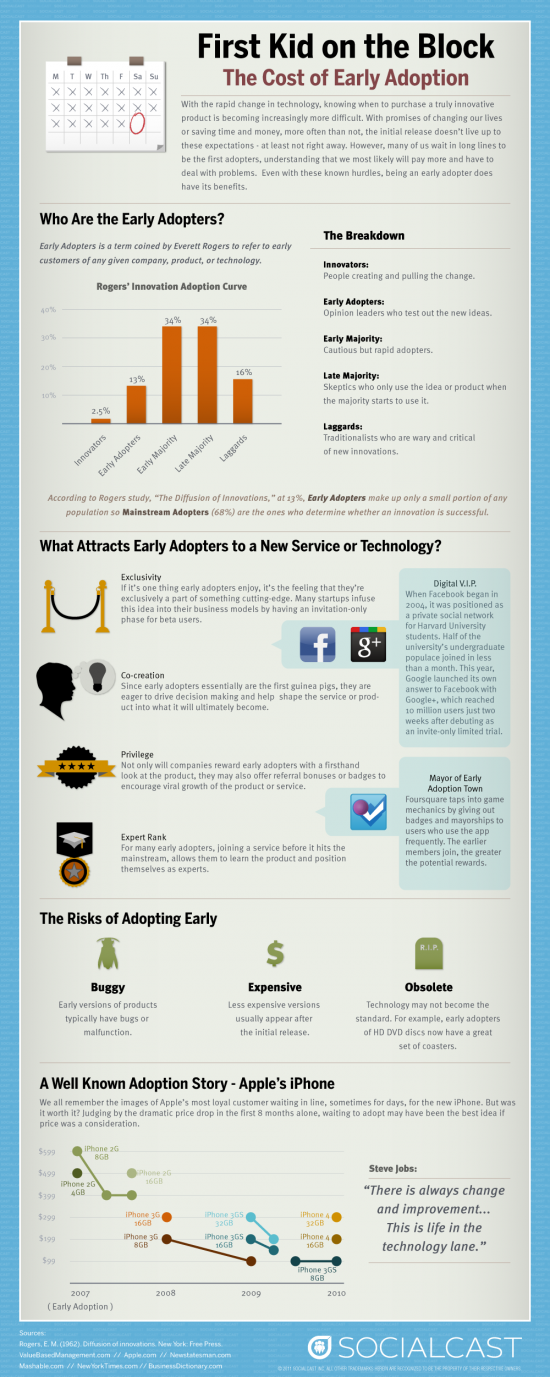
With the rapid change in technology, such as eHRs, knowing when to purchase a truly innovative product is becoming increasingly more difficult. With promises of changing our lives or saving time and money, more often than not, the initial release doesn’t live up to these expectations – at least not right away.
Brought to you by www.socialcast.com
Assessment
However, many of us – doctors included – wait in long lines to be the first adopters, understanding that we most likely will pay more and have to deal with problems. Even with these known hurdles, being an early adopter does have its benefits.
Conclusion
And so, your thoughts and comments on this ME-P are appreciated. Feel free to review our top-left column, and top-right sidebar materials, links, URLs and related websites, too. Then, subscribe to the ME-P. It is fast, free and secure.
Link: http://feeds.feedburner.com/HealthcareFinancialsthePostForcxos
Speaker: If you need a moderator or speaker for an upcoming event, Dr. David E. Marcinko; MBA – Publisher-in-Chief of the Medical Executive-Post – is available for seminar or speaking engagements. Contact: MarcinkoAdvisors@msn.com
Our Other Print Books and Related Information Sources:
Health Dictionary Series: http://www.springerpub.com/Search/marcinko
Practice Management: http://www.springerpub.com/product/9780826105752
Physician Financial Planning: http://www.jbpub.com/catalog/0763745790
Medical Risk Management: http://www.jbpub.com/catalog/9780763733421
Healthcare Organizations: www.HealthcareFinancials.com
Physician Advisors: www.CertifiedMedicalPlanner.com
Subscribe Now: Did you like this Medical Executive-Post, or find it helpful, interesting and informative? Want to get the latest ME-Ps delivered to your email box each morning? Just subscribe using the link below. You can unsubscribe at any time. Security is assured.
Link: http://feeds.feedburner.com/HealthcareFinancialsthePostForcxos
Sponsors Welcomed: And, credible sponsors and like-minded advertisers are always welcomed.
Link: https://healthcarefinancials.wordpress.com/2007/11/11/advertise

Share this:

Filed under: Information Technology | Tagged: early technology adopters, EHRs, EMRs, Health I.T., www.socialcast.com. |
 The Leading Business Education Network for Doctors, Financial Advisors and Health Industry Consultants
CMS Releases Final Rule on eRx Incentive Program Changes for eHRs
The CMS’ final rule on changes to the federal e-prescribing incentive program for 2011 includes additional hardship exemptions and more time for providers to obtain such exemptions.
The final rule also will extend the deadline for requesting significant-hardship exemptions to November 1, 2011. The program creates financial incentives and penalties to encourage the use of digital prescriptions by healthcare providers participating in Medicare.
Under the final rule, issued Wednesday and scheduled to be published in the Federal Register on September 6th, there are additional significant-hardship exemption categories to help providers avoid the Medicare payment cuts they would face beginning in 2012 for not meeting e-prescribing targets. The new exemptions apply to providers participating in the Medicare or Medicaid EHR incentive programs that adopt certified EHR technology.
Source: Rich Daly, Modern Healthcare [8/31/11]
LikeLike
EHR Vendors Take Aim at Proposed Patient-Level Data Rule
Electronic health-record system vendors are asking the CMS to roll back a proposed Medicare rule change that would require providers to report patient-level data for clinical quality improvement and rely on the reporting of aggregate quality data instead.
The vendors, members of the Electronic Health Record Association, an affiliate of the Chicago-based Healthcare Information and Management Systems Society, stated in a news release that the proposed rule for the 2012 Medicare Physician Fee Schedule (MPFS) and the Hospital Outpatient Prospective Payment System should be reconsidered “based on the burden it would impose on provider organizations and other considerations.”
Source: Joseph Conn, Health IT Strategist [8/31/11]
LikeLike
A National eHR Safety Board?
Joseph Goedert posted “New Report Echoes Call for National EHR Safety Board” today.
http://www.healthdatamanagement.com/news/ehr-electronic-health-records-safety-reporting-43640-1.html
He writes: “A new report published in the Journal of Patient Safety advocates creation of an independent national board to monitor and improve the safety of electronic health records. Among other duties, the board would have the power to implement unannounced, randomly scheduled, on-site EHR safety inspections.”
Oh goody!
“The EHR safety board could be modeled after the National Transportation Safety Board. To support the new national board, institutional EHR safety committees, including a designated EHR patient safety officer, would investigate and report all known safety incidents in an organization and perform routine safety self-assessments.”
So is the new national safety board likely to make EHRs cheaper or more expensive?
D. Kellus Pruitt DDS
LikeLike
5 reasons EHR functionality hasn’t changed since 1982
Despite progress and incentives, usability remains an issue for electronic health records. Booz Allen Hamilton consultants explain why, and point to 4 themes on the future of EHRs in this essay.
http://www.govhealthit.com/news/5-reasons-ehr-functionality-hasnt-changed-1982?topic=08,12,
Jackson
LikeLike
Doubting the cost savings of health information technology
According to Jennifer Shine Dyer MD MPH a recent Health Affairs article casts doubt on the cost-saving prospects of health information technology despite the significant investments made by hospitals, physicians, and the federal government to promote electronic records.
http://www.kevinmd.com/blog/2012/03/doubting-cost-savings-health-information-technology.html
Susan
LikeLike
HIT Foibles
One big problem in healthcare IT adoption, as I see it, is the use of uncommon technology platforms, formats, languages, etc.
Now, none of the various healthcare technology solutions can talk to each other with ease. With that, information has to be entered again and again into different places or providers have to pay for expensive fees to link the software through interface.
Yes, there have been some improvements with CCR, CCD, HL7 etc; but it is not enough. HIT is still not ready for prime time.
Kurt
LikeLike
50% Looked Up Health Information on the Internet in 2015
The Centers for Disease Control recently released results from the National Health Interview Survey on health information technology use. Here are some key findings from the report:
• 3.7% used online chat groups to learn about a health topic in the past 12 months.
• Half of everyone surveyed looked up health information on the internet in 2015.
• 8.7% filled a prescription online in the past 12 months.
• 1 in 10 scheduled an appointment with a healthcare provider online in 2015.
• 11.2% communicated with a health provider by email in the past 12 months.
• 3 in 4 with advanced degrees looked up health information online, vs. 35% of high school graduates.
Source: CDC, May 18, 2016
LikeLike