





 Support our online development, and advance our onground research initiatives in free market economics, as we seek to showcase the brightest Next-Gen minds.
THE ME-P DISCLAIMER: Posts, comments and opinions do not necessarily represent iMBA, Inc., but become our property after submission. Copyright © 2006 to-date. iMBA, Inc allows colleges, universities, medical and financial professionals and related clinics, hospitals and non-profit healthcare organizations to distribute our proprietary essays, photos, videos, audios and other documents; etc. However, please review copyright and usage information for each individual asset before submission to us, and/or placement on your publication or web site. Attestation references, citations and/or back-links are required. All other assets are property of the individual copyright holder.
Support our online development, and advance our onground research initiatives in free market economics, as we seek to showcase the brightest Next-Gen minds.
THE ME-P DISCLAIMER: Posts, comments and opinions do not necessarily represent iMBA, Inc., but become our property after submission. Copyright © 2006 to-date. iMBA, Inc allows colleges, universities, medical and financial professionals and related clinics, hospitals and non-profit healthcare organizations to distribute our proprietary essays, photos, videos, audios and other documents; etc. However, please review copyright and usage information for each individual asset before submission to us, and/or placement on your publication or web site. Attestation references, citations and/or back-links are required. All other assets are property of the individual copyright holder.


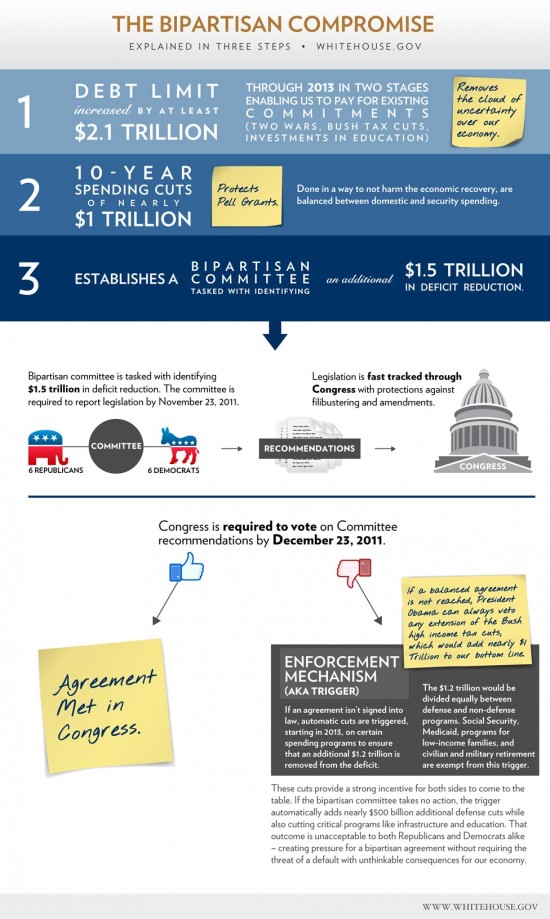
The Bi-Partisan Compromise

The recent budget compromise created a joint committee of Congress, which you might have seen referred to as the “super committee.”
This committee is responsible for developing a bipartisan plan for reducing our deficit by $1.5 trillion over the next 10 years. (That’s on top of about $1 trillion from the down payment that was included in the first phase of the deal.)
Brought to you by The White House.
Conclusion
And so, your thoughts and comments on this ME-P are appreciated. Feel free to review our top-left column, and top-right sidebar materials, links, URLs and related websites, too. Then, subscribe to the ME-P. It is fast, free and secure.
Link: http://feeds.feedburner.com/HealthcareFinancialsthePostForcxos
Our Other Print Books and Related Information Sources:
Health Dictionary Series: http://www.springerpub.com/Search/marcinko
Practice Management: http://www.springerpub.com/product/9780826105752
Physician Financial Planning: http://www.jbpub.com/catalog/0763745790
Medical Risk Management: http://www.jbpub.com/catalog/9780763733421
Healthcare Organizations: www.HealthcareFinancials.com
Physician Advisors: www.CertifiedMedicalPlanner.com
Subscribe Now: Did you like this Medical Executive-Post, or find it helpful, interesting and informative? Want to get the latest ME-Ps delivered to your email box each morning? Just subscribe using the link below. You can unsubscribe at any time. Security is assured.
Link: http://feeds.feedburner.com/HealthcareFinancialsthePostForcxos
Sponsors Welcomed: And, credible sponsors and like-minded advertisers are always welcomed.
Link: https://healthcarefinancials.wordpress.com/2007/11/11/advertise



Share this:

Filed under: Taxation | Tagged: national debt, U.S. Debt Ceiling |
 The Leading Business Education Network for Doctors, Financial Advisors and Health Industry Consultants
Where does our national debt come from?
One of the fundamental things to understand when considering the debate about reducing our national debt is how we accumulated so much in the first place.
To explain the impact various policies have had over the past decade, shifting us from projected surpluses to actual deficits and, as a result, running up the national debt, the White House has developed a graphic for you.
http://www.infographicsarchive.com/politics/where-does-our-national-debt-come-from/
Source: Brought to you by http://www.Whitehouse.gov
LikeLike
Obama jobs bill would raise revenue by taxing health benefits for wealthy
Did you know that a little-noticed provision in President Obama’s new jobs bill proposes a controversial idea that went nowhere during the healthcare reform debate?
http://thehill.com/blogs/healthwatch/taxes-and-fees/181363-obama-jobs-bill-would-tax-health-benefits-for-wealthy
Drew
LikeLike
Supercommittee Deadline Approaches
At publication time, the six Democrats and six Republicans of the Supercommittee appear to be quite far apart as the November 23 deadline approaches. Given the very limited time available, the prospects for agreement appear to be growing rather slim.
If there is no agreement on a deficit solution of $1.2 trillion or more, then in 2013 there will be substantial cuts for both defense and Medicare providers. The $1.2 trillion in cuts will be allocated over the next decade.
The Supercommittee Co-Chairs are Rep. Jeb Hensarling (R-TX) and Sen. Patty Murray (D-WA). In a media interview this week, Hensarling indicated that tax increases are “not going to happen.” He stated, “We’re facing a jobs crisis and a debt crisis. We’re certainly not going to exacerbate one by trying to address the other.” Hensarling noted that Republicans had made a concession by offering $250 billion in new revenue as part of a plan to lower the top individual rate to 28%. The six Democrats on the committee are discussing plans and may offer an alternative during the weekend.
A bipartisan group of senators and representatives held a press conference this week. House Democratic Whip Steny H. Hoyer (D-MD) spoke for the group and expressed a hope that a “Go Big” plan that involves a $4 trillion solution could be reached. He stated, “The committee, for the sake of our country and its sound fiscal future, should recommend a package of cuts, revenues and reforms consistent with the Bowles-Simpson, Domenici-Rivlin, and Gang of Six proposals.”
If there is no agreement, Senate Majority Leader Harry Reid (D-NV) stated that he will not block the $1.2 trillion in automatic spending cuts. In addition, President Obama placed a phone call to Co-Chairs Hensarling and Murray. He also indicated that the White House would not stop the automatic reductions.
Editor’s Note: Under the Budget Control Act of 2011, which created the Supercommittee and mandates the potential budget cuts, the Congressional Budget Office must score any bill two days prior to the deadline. Therefore, the actual deadline for action is Monday, November 21, 2011. A compromise by the Supercommittee must be reached this weekend in order for a committee vote on November 23rd, 2011.
Source: Children’s Home Society of Florida Foundation
LikeLike
Senators Prepare Budget Compromise III
On a national network news program this week, Senate Democratic Assistant Majority Leader Richard Durbin (D-IL) was asked about a potential budget compromise. He indicated that he is working with a bipartisan group of senators to create a budget compromise that could be voted on in November.
Durbin stated, “We have something in legislative language. It’s not done, but we’re working. I’m hoping to have the [help of] members on both sides of the aisle to getting it on the floor the day after the election.”
Durbin hopes that a bipartisan group of senators will support a vote on November 7. This is the third major bipartisan effort to craft a budget compromise. The first effort was the National Commission on Fiscal Responsibility and Reform, with Co-Chairs Alan Simpson and Erskine Bowles. Eleven of the 18 congressional leaders on the Commission voted in favor of the plan, but it was not enacted by Congress.
Following the Simpson-Bowles Commission efforts, a “Gang of Six” senators from both parties attempted to use the Simpson-Bowles Commission framework to develop a bipartisan compromise. This also was not successful.
The present effort includes Senators Kent Conrad (D-ND), Tom Coburn (R-OK), Mike Crapo (R-ID), Mark Warner (D-VA), Michael Bennet (D-CO), Saxby Chambliss (R-GA), Mike Johanns (R-NE) and Durbin. The four Democrats and four Republicans hope to hold a vote on their plan following the November election.
Source: Children’s Home Society of Florida Foundation
Editor’s Note: Most bipartisan plans historically have started in the Senate. However, it will also require an agreement by the White House and the House majority. If there is no agreement and no action this year, there will be very large income tax increases and budget cuts on January 1, 2013. The Congressional Budget Office has indicated that there is a substantial risk of recession in 2013 if this combination of tax increases and budget cuts occur. While the bipartisan Senate approach has not been successful in the past, there are reasonable prospects to hope that this framework for the budget solution will be helpful in the November negotiations.
LikeLike