







 Support our online development, and advance our onground research initiatives in free market economics, as we seek to showcase the brightest Next-Gen minds.
THE ME-P DISCLAIMER: Posts, comments and opinions do not necessarily represent iMBA, Inc., but become our property after submission. Copyright © 2006 to-date. iMBA, Inc allows colleges, universities, medical and financial professionals and related clinics, hospitals and non-profit healthcare organizations to distribute our proprietary essays, photos, videos, audios and other documents; etc. However, please review copyright and usage information for each individual asset before submission to us, and/or placement on your publication or web site. Attestation references, citations and/or back-links are required. All other assets are property of the individual copyright holder.
Support our online development, and advance our onground research initiatives in free market economics, as we seek to showcase the brightest Next-Gen minds.
THE ME-P DISCLAIMER: Posts, comments and opinions do not necessarily represent iMBA, Inc., but become our property after submission. Copyright © 2006 to-date. iMBA, Inc allows colleges, universities, medical and financial professionals and related clinics, hospitals and non-profit healthcare organizations to distribute our proprietary essays, photos, videos, audios and other documents; etc. However, please review copyright and usage information for each individual asset before submission to us, and/or placement on your publication or web site. Attestation references, citations and/or back-links are required. All other assets are property of the individual copyright holder.


Not a Unique Experience

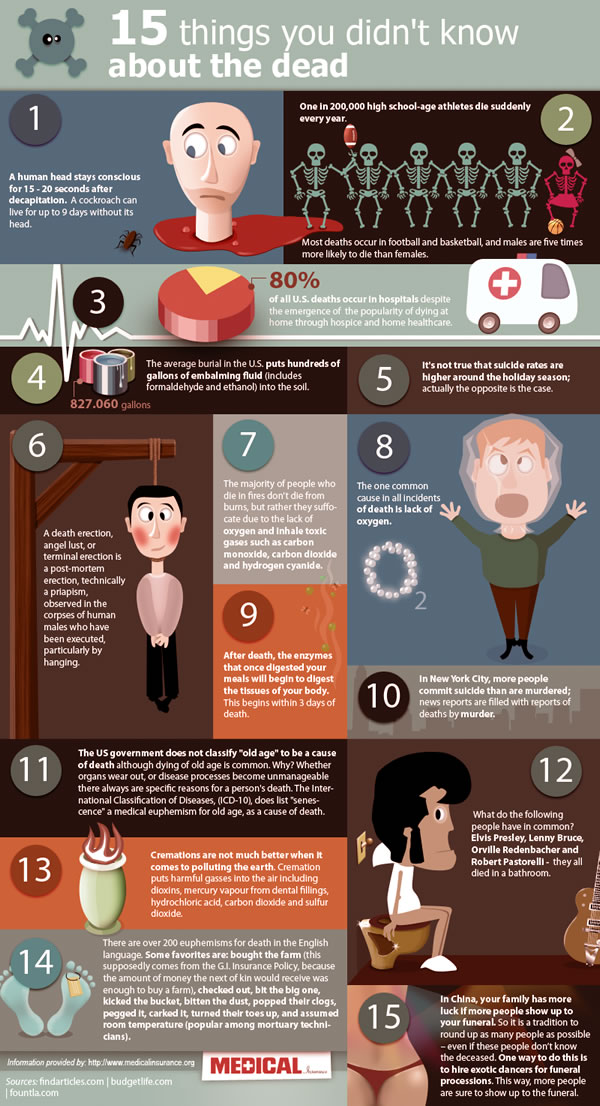
Death is an experience that we’re all going to have at one point or another. Why not take a few minutes to learn some interesting and some truly bizarre facts about death, dying, and the dead? Brought to you by medicalinsurance.org
Conclusion
Your thoughts and comments on this ME-P are appreciated. Feel free to review our top-left column, and top-right sidebar materials, links, URLs and related websites, too. Then, subscribe to the ME-P. It is fast, free and secure.
Speaker: If you need a moderator or speaker for an upcoming event, Dr. David E. Marcinko; MBA – Publisher-in-Chief of the Medical Executive-Post – is available for seminar or speaking engagements. Contact: MarcinkoAdvisors@msn.com
OUR OTHER PRINT BOOKS AND RELATED INFORMATION SOURCES:
- PRACTICES: www.BusinessofMedicalPractice.com
- HOSPITALS: http://www.crcpress.com/product/isbn/9781466558731
- CLINICS: http://www.crcpress.com/product/isbn/9781439879900
- ADVISORS: www.CertifiedMedicalPlanner.org
- FINANCE: Financial Planning for Physicians and Advisors
- INSURANCE: Risk Management and Insurance Strategies for Physicians and Advisors
- Dictionary of Health Economics and Finance
- Dictionary of Health Information Technology and Security
- Dictionary of Health Insurance and Managed Care


Share this:

Filed under: Ethics, Insurance Matters | Tagged: bizarre facts about death, cadavers, corpse, dead, dying, Estate Planning, life insurance, Risk Management |
 The Leading Business Education Network for Doctors, Financial Advisors and Health Industry Consultants
Predicting Death
One of the toughest jobs a physician has is imparting bad news, and it is crucial for a physician to be able to predict death accurately when informing a patient. Despite various models developed to predict mortality, the evidence suggests that physicians perform poorly in this area.
http://physiciansmoneydigest.com/your-practice/Predicting-Death
Dr. Jason
LikeLike
Medical Errors and the Death Penalty?
What the death penalty has to do with medical errors?
Here is a fascinating, beautifully-written article on a death penalty granted to a most likely innocent man, with interesting details on fire dynamics and the history of the judicial system pertaining to the death penalty.
http://www.kevinmd.com/blog/2011/08/death-penalty-medical-errors.html
Clare
LikeLike
More About The Death Penalty
The American public has grown slightly more uneasy about capital punishment over time, but more than 60 percent still support the death penalty.
http://www.infographicsarchive.com/politics/changing-attitudes-about-the-death-penalty/
Source: Brought to you by GOOD and Column Five Media.
LikeLike
Funerals for the Unclaimed?
Rest in peace [RIP]. These words are a common theme at funerals honoring loved ones. But, did you klnow that many people die with no one claiming their bodies?
http://www.kevinmd.com/blog/2011/08/hold-funerals-unclaimed-dead-bodies.html
Laura
LikeLike
End-of-Life Discussions Do Not Affect Survival Rates
Discussing and documenting patients’ preferences for care at the end of life does not cause them any harm, contrary to recent claims.
For example, a new study in the Journal of Hospital Medicine found that patients who talk with their physicians about end-of-life care and have an advance directive in their medical record have similar survival rates as patients who do not have these discussions and documents.
http://thielst.typepad.com/my_weblog/2011/09/end-of-life-discussions-do-not-affect-survival-rates.html
Karen
LikeLike
RIP … the Autopsy
Once, the autopsy was a venerated tool for medical advancement and humility. An invaluable means of learning one’s own limitations and the extraordinary diversity in nature and human physiology, it has now become an un-reimbursed after-thought.
An irrelevant thing, especially since the patient is already dead, there are living patients to care for, and people just need to “move on.”
An interesting article by Sandra G. Gompf, MD
http://www.kevinmd.com/blog/2011/12/eulogy-autopsy-call-return.html
Hope Rachel Hetico RN MHA
[Managing Editor]
LikeLike
How Doctors Die
Years ago, Charlie, a highly respected orthopedist and a mentor of mine, found a lump in his stomach. He had a surgeon explore the area, and the diagnosis was pancreatic cancer. This surgeon was one of the best in the country. He had even invented a new procedure for this exact cancer that could triple a patient’s five-year-survival odds—from 5 percent to 15 percent—albeit with a poor quality of life. Charlie was uninterested. He went home the next day, closed his practice, and never set foot in a hospital again. He focused on spending time with family and feeling as good as possible.
Several months later, he died at home. He got no chemotherapy, radiation, or surgical treatment. Medicare didn’t spend much on him.
http://thehealthcareblog.com/blog/2011/12/16/how-doctors-die/
Dr. David E. Marcinko MBA
LikeLike
Why Can’t Linda Carswell Get Her Husband’s Heart Back?
[More on the vanishing autopsy]
For almost eight years, Linda Carswell has been trying to find out how her husband died. Her quest has led to a fraud judgment against a hospital as well as autopsy reform in Texas.
But, she’s still seeking answers — and the return of his heart.
http://www.propublica.org/article/why-cant-linda-carswell-get-her-husbands-heart-back
Your esteemed thoughts?
Pearl
LikeLike
Doctors seek Hospira action on Execution Medication
An international group of doctors is putting the squeeze on Hospira ($HSP) over a drug now being used for executions by U.S. death-penalty states.
Writing in The Lancet, 25 physicians said Hospira should follow the example of Denmark’s Lundbeck, which restricted distribution of its anesthetic pentobarbital to keep it out of executioners’ hands.
http://www.thelancet.com/journals/lancet/article/PIIS0140-6736%2812%2960013-0/fulltext?rss=yes
Dr. Lawrence
LikeLike
Assisted Dying Without the Doctor
Dr. Lynda Young, former president of the Massachusetts Medical Society, spoke in March to a legislative committee considering a bill that would permit physicians to prescribe life-ending drugs to patients with a terminal illnesses. She cited the AMA’s long-standing policy: “Physician-assisted suicide is fundamentally incompatible with the physician’s role as healer.” Members of Young’s organization have repeatedly voted to object to such a change in their role.
http://www.boston.com/whitecoatnotes/2012/07/12/assisted-dying-without-the-doctor/oXqQYicMqaazlG8THxTlpN/story.html
But, what if the sickest patients could end their lives in a way sanctioned by law without direct involvement from their doctors?
Mandy
LikeLike
Medicare wants to pay doctors to talk about death. Expect political controversy
The Obama administration plans to pay doctors to hold end-of-life planning conversations with patients, a controversial decision that will almost certainly revive the “death panel” debate that has long dogged the Affordable Care Act.
http://www.msn.com/en-us/money/insurance/medicare-wants-to-pay-doctors-to-talk-about-death-expect-political-controversy/ar-AAcJocw?ocid=iehp
Medicare rolled out new rules Wednesday (on page 246 of this document) that would reimburse physicians who talk to elderly patients about what options are available at the end of life — whether they would want life support, for example, or whether hospice care would be of interest. Doctors would get paid, under these new rules, for helping patients complete an advance directive.
The reimbursements would begin in 2016.
Ortiz
LikeLike