







 Support our online development, and advance our onground research initiatives in free market economics, as we seek to showcase the brightest Next-Gen minds.
THE ME-P DISCLAIMER: Posts, comments and opinions do not necessarily represent iMBA, Inc., but become our property after submission. Copyright © 2006 to-date. iMBA, Inc allows colleges, universities, medical and financial professionals and related clinics, hospitals and non-profit healthcare organizations to distribute our proprietary essays, photos, videos, audios and other documents; etc. However, please review copyright and usage information for each individual asset before submission to us, and/or placement on your publication or web site. Attestation references, citations and/or back-links are required. All other assets are property of the individual copyright holder.
Support our online development, and advance our onground research initiatives in free market economics, as we seek to showcase the brightest Next-Gen minds.
THE ME-P DISCLAIMER: Posts, comments and opinions do not necessarily represent iMBA, Inc., but become our property after submission. Copyright © 2006 to-date. iMBA, Inc allows colleges, universities, medical and financial professionals and related clinics, hospitals and non-profit healthcare organizations to distribute our proprietary essays, photos, videos, audios and other documents; etc. However, please review copyright and usage information for each individual asset before submission to us, and/or placement on your publication or web site. Attestation references, citations and/or back-links are required. All other assets are property of the individual copyright holder.


An InfoGraphic

[By Bertalan Mesko MD PhD]
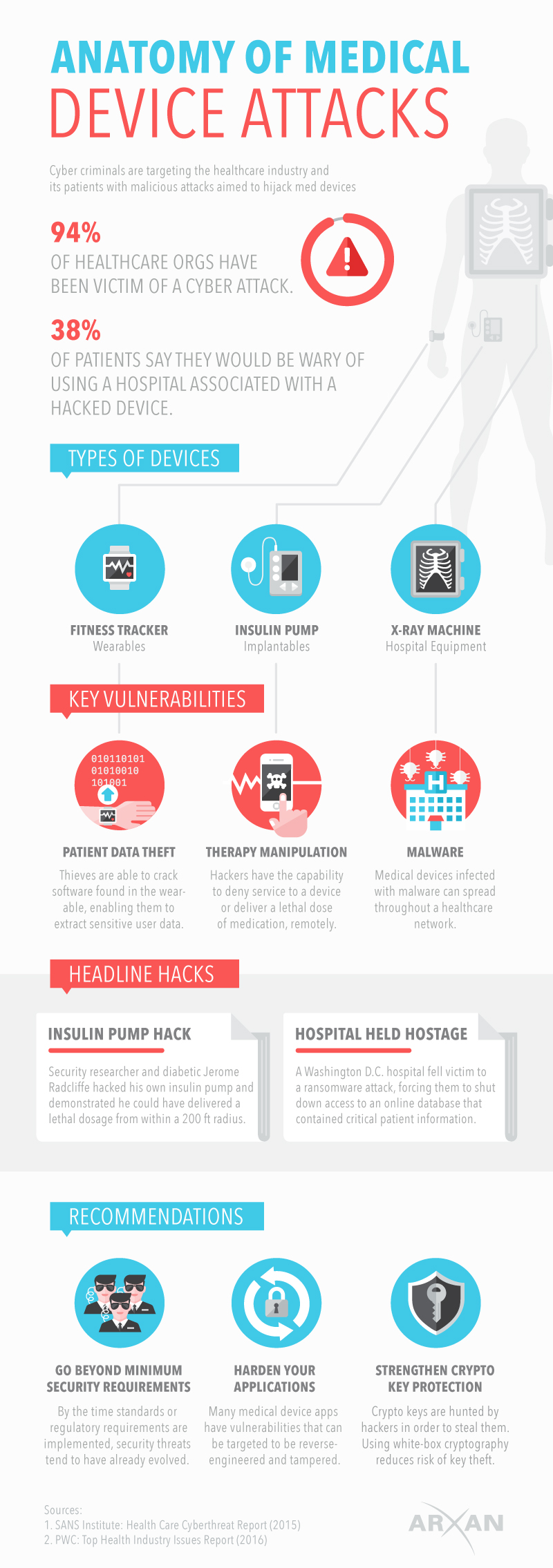
An overwhelming majority of healthcare organizations have been victims of cyber-attacks. As digital health spreads from wearable devices on our body to implantables inside it, cyber threats can become painfully real.
What can we do to protect against them today?
Assessment
Let’s see some other dangers facing our health information, and a few easy tips you can use to boost your privacy levels quickly. Arxan recently surveyed trends and dangers threatening the privacy of healthcare data.
Conclusion
Your thoughts and comments on this ME-P are appreciated. Feel free to review our top-left column, and top-right sidebar materials, links, URLs and related websites, too. Then, subscribe to the ME-P. It is fast, free and secure.
Speaker: If you need a moderator or speaker for an upcoming event, Dr. David E. Marcinko; MBA – Publisher-in-Chief of the Medical Executive-Post – is available for seminar or speaking engagements. Contact: MarcinkoAdvisors@msn.com
OUR OTHER PRINT BOOKS AND RELATED INFORMATION SOURCES:
- PRACTICES: www.BusinessofMedicalPractice.com
- HOSPITALS: http://www.crcpress.com/product/isbn/9781466558731
- CLINICS: http://www.crcpress.com/product/isbn/9781439879900
- ADVISORS: www.CertifiedMedicalPlanner.org
- FINANCE: Financial Planning for Physicians and Advisors
- INSURANCE: Risk Management and Insurance Strategies for Physicians and Advisors
- Dictionary of Health Economics and Finance
- Dictionary of Health Information Technology and Security
- Dictionary of Health Insurance and Managed Care


***
Share this:

Filed under: Information Technology | Tagged: Bertalan Meskó, Defending online privacy in healthcare |
 The Leading Business Education Network for Doctors, Financial Advisors and Health Industry Consultants
Watch Your PC/Phone/Tablet Camera and Mic!
The taped-over camera and microphone jack are usually a signal that someone is concerned, perhaps only vaguely, about hackers’ gaining access to his or her devices by using remote-access trojans — a process called “ratting.”
Remote access is not limited to ratters: According to a cache of National Security Agency documents leaked by Edward J. Snowden, at least two government-designed programs were devised to take over computer cameras and microphones.
Noah
LikeLike
NOPE,
Accenture recently released results from a survey on healthcare employee attitudes toward confidential data. Here are some key findings from the report:
• 18% of health employees said they would be willing to sell confidential data.
• Respondents willing to sell data would do so for as little as $500-$1,000.
• 21% from provider versus 12% from payer organizations would sell data.
• 1 in 4 know of someone in their organization who has sold access to an outsider.
• 21% keep their user name and password written down next to their computer.
• 9 in 10 respondents said that their organization provides security training.
Source: Accenture, March 1, 2018
LikeLiked by 1 person
Total Information Awareness
(TIA) was a program of the United States Information Awareness Office that began during the 2003 fiscal year. It operated under this title from February until May 2003, before being renamed as the Terrorism Information Awareness.
https://en.wikipedia.org/wiki/Total_Information_Awareness
Ann Miller RN MHA
LikeLike