





 Support our online development, and advance our onground research initiatives in free market economics, as we seek to showcase the brightest Next-Gen minds.
THE ME-P DISCLAIMER: Posts, comments and opinions do not necessarily represent iMBA, Inc., but become our property after submission. Copyright © 2006 to-date. iMBA, Inc allows colleges, universities, medical and financial professionals and related clinics, hospitals and non-profit healthcare organizations to distribute our proprietary essays, photos, videos, audios and other documents; etc. However, please review copyright and usage information for each individual asset before submission to us, and/or placement on your publication or web site. Attestation references, citations and/or back-links are required. All other assets are property of the individual copyright holder.
Support our online development, and advance our onground research initiatives in free market economics, as we seek to showcase the brightest Next-Gen minds.
THE ME-P DISCLAIMER: Posts, comments and opinions do not necessarily represent iMBA, Inc., but become our property after submission. Copyright © 2006 to-date. iMBA, Inc allows colleges, universities, medical and financial professionals and related clinics, hospitals and non-profit healthcare organizations to distribute our proprietary essays, photos, videos, audios and other documents; etc. However, please review copyright and usage information for each individual asset before submission to us, and/or placement on your publication or web site. Attestation references, citations and/or back-links are required. All other assets are property of the individual copyright holder.


What’s possible with healthcare and how it might be achieved?
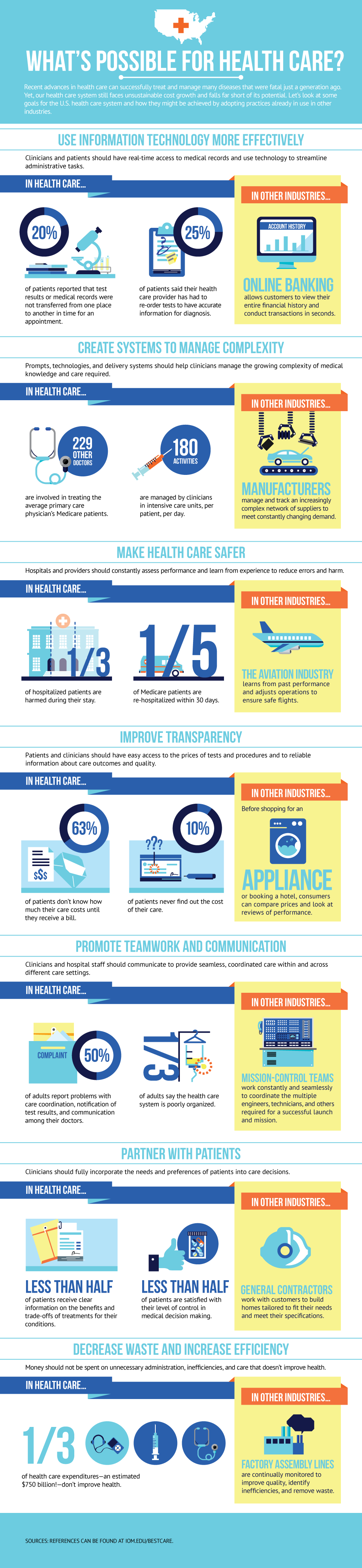
The following infographic created by IOM highlights that despite recent advances in healthcare as the system continues to fall short of its potential.
So, what’s possible for healthcare?
Assessment
These 7 disruptive goals and how they might be achieved by adopting practices that are currently in use in by other industries include:
- Use Information Technology More Effectively
- Create Systems to Manage Complexity
- Make Health Care Safer
- Improve Transparency
- Promote Teamwork & Communication
- Partner With Patients
- Decrease Waste & Increase Efficiency
Conclusion
Your thoughts and comments on this ME-P are appreciated. Feel free to review our top-left column, and top-right sidebar materials, links, URLs and related websites, too. Then, subscribe to the ME-P. It is fast, free and secure.
Link: http://feeds.feedburner.com/HealthcareFinancialsthePostForcxos
Speaker: If you need a moderator or speaker for an upcoming event, Dr. David E. Marcinko; MBA – Publisher-in-Chief of the Medical Executive-Post – is available for seminar or speaking engagements. Contact: MarcinkoAdvisors@msn.com
Our Other Print Books and Related Information Sources:
Health Dictionary Series: http://www.springerpub.com/Search/marcinko
Practice Management: http://www.springerpub.com/product/9780826105752
Physician Financial Planning: http://www.jbpub.com/catalog/0763745790
Medical Risk Management: http://www.jbpub.com/catalog/9780763733421
Hospitals: http://www.crcpress.com/product/isbn/9781439879900
Physician Advisors: www.CertifiedMedicalPlanner.org

Share this:

Filed under: Information Technology | Tagged: disruptive healthcare, health 2.0, Seven Goals for Healthcare Disruption |
 The Leading Business Education Network for Doctors, Financial Advisors and Health Industry Consultants
HISTORICAL PERSPECTIVES ON “DISRUPTORS”
Did you know that France dominated medicine until about 1870 & then Germany. But, since the “Flexner Report” you could say America has had the best doctors in the world.
Yet today, American physicians aren’t recommending medicine to their children; even my own child eschewed medical school to my [ultimate] delight and academically surpassed me in short order. The profession has been depersonalized by an alphabet soup of reforms with some evidence, little evidence, or mind you none at all.
The IOM says it takes an average 17 years for documented scientific facts to percolate into medical practice. So, the next revolution in medicine will not be televised or mandated from congress; nor from the planned impersonal and technical ABJ troika.
No, it’ll be found in the relationship between a physician & a patient. And, like the philosopher Lawrence Ferlinghetti said, “I am anxiously waiting for the secret to enteral life to be discovered by an obscure general practitioner.”
SIDEBAR: Bill Gates, the former CEO of Microsoft, was once asked what kept him up at night. He replied that it was not IBM, Apple, or a competitor, etc. Rather, he worried about a solitary college kid in his/her door room plotting to take MSFT down. And, he should know as that same college dropout who did take down IBM, won the OS and browser wars, as MSFT is once again the most valuable and innovative corporation on the planet.
Disruptive innovation can’t be planned or engineered. It arises in the gut with passion and … organically.
Any thoughts?
Dr. David E. Marcinko MBA
LikeLike