





 Support our online development, and advance our onground research initiatives in free market economics, as we seek to showcase the brightest Next-Gen minds.
THE ME-P DISCLAIMER: Posts, comments and opinions do not necessarily represent iMBA, Inc., but become our property after submission. Copyright © 2006 to-date. iMBA, Inc allows colleges, universities, medical and financial professionals and related clinics, hospitals and non-profit healthcare organizations to distribute our proprietary essays, photos, videos, audios and other documents; etc. However, please review copyright and usage information for each individual asset before submission to us, and/or placement on your publication or web site. Attestation references, citations and/or back-links are required. All other assets are property of the individual copyright holder.
Support our online development, and advance our onground research initiatives in free market economics, as we seek to showcase the brightest Next-Gen minds.
THE ME-P DISCLAIMER: Posts, comments and opinions do not necessarily represent iMBA, Inc., but become our property after submission. Copyright © 2006 to-date. iMBA, Inc allows colleges, universities, medical and financial professionals and related clinics, hospitals and non-profit healthcare organizations to distribute our proprietary essays, photos, videos, audios and other documents; etc. However, please review copyright and usage information for each individual asset before submission to us, and/or placement on your publication or web site. Attestation references, citations and/or back-links are required. All other assets are property of the individual copyright holder.


A Historic Timeline Review of Advances

Today we address how technology has changed the medical industry.
Definition
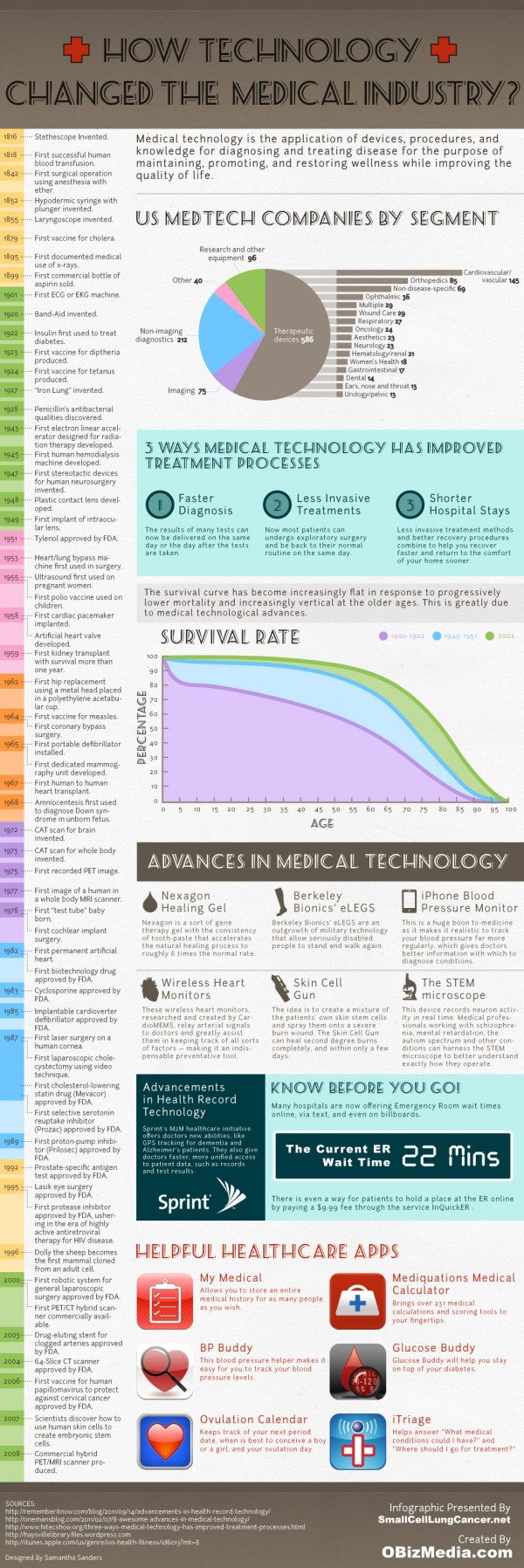
This infographic starts off by stating “medical technology is the application of devices, procedures, and knowledge for diagnosing and treating disease for the purpose of maintaining, promoting, and restoring wellness while improving the quality of life.” On the left of the infographic is a timeline of technological advances in the medical industry, starting with the invention of the stethoscope in 1816 and ending with the production of the first commercial hybrid PET/MRI scanner in 2008.
US Medical Technology Companies by Segment
A pie chart shows us that a great many medical technology companies are focused on therapeutic devices, while the next biggest segment belongs to non-imaging diagnostics. The next largest segment is dedicated to research and other equipment, and the next segment (second to the smallest) is dedicated to imaging. The smallest segment is designated as “other.”
In the therapeutic devices category, the largest piece of that piece of the pie goes to cardiovascular and vascular developments, and the smallest to urology/pelvic with many other therapeutic devices in between.
Three Ways Medical Technology Has Improved Treatment Processes
1. Faster Diagnosis
2. Less Invasive Treatments
3. Shorter Hospital Stays
Survival Rate
It is noted that the survival curve has flattened because of lower mortality and has become increasingly vertical with older people because of the technological advances. A graph shows the percentage of people who lived until a certain age between 1900 and 1902, when only about 10% of people lived past the age of 85, and 2002, when almost 30% of people lived past the age of 85. Based on this graph, most people live to age 55 or older; and around 50% of people live to at least age 80.
Advances in Medical Technology
Some of the advances mentioned are wireless heart monitors, skin cell guns, the STEM microscope, Nexagon healing gel, Berkeley Bionics’ eLEGS, and the iPhone Blood Pressure Monitor. A description of each of these advances is included on the infographic.
Advancements in Health Record Technology and More
Sprint has something called M2M healthcare initiative that provides GPS tracking for patients with Alzheimer’s and dementia, and offers faster access to more unified personal data like heath records and test results.
Now, there is also a “know before you go” option for hospital emergency rooms. Some hospitals place their wait times on billboards, make them available on their website, and even offer the wait time via text. Other hospitals participate in a service called InQuick ER where a patient can pay a $9.99 fee and hold a place in the ER online [noted elsewhere on this ME-P].
Helpful Healthcare Apps
Some of the apps listed are My Medical, which allows one to store medical histories, BP Buddy that helps track blood pressure levels, Glucose Buddy, which helps manage diabetes, and iTriage, that is a diagnostic tool.
Also listed is the Ovulation Calendar – guess what that does? While – the Mediquations Medical Calculator brings 231 medical calculations and scoring tools right to your mobile device.
Source: SmallCellLungCancer.net
Conclusion
Your thoughts and comments on this ME-P are appreciated. Feel free to review our top-left column, and top-right sidebar materials, links, URLs and related websites, too. Then, subscribe to the ME-P. It is fast, free and secure.
Speaker: If you need a moderator or speaker for an upcoming event, Dr. David E. Marcinko; MBA – Publisher-in-Chief of the Medical Executive-Post – is available for seminar or speaking engagements. Contact: MarcinkoAdvisors@msn.com
OUR OTHER PRINT BOOKS AND RELATED INFORMATION SOURCES:
- DICTIONARIES: http://www.springerpub.com/Search/marcinko
- PHYSICIANS: www.MedicalBusinessAdvisors.com
- PRACTICES: www.BusinessofMedicalPractice.com
- HOSPITALS: http://www.crcpress.com/product/isbn/9781466558731
- CLINICS: http://www.crcpress.com/product/isbn/9781439879900
- ADVISORS: www.CertifiedMedicalPlanner.org
- BLOG: www.MedicalExecutivePost.com
- FINANCE:Financial Planning for Physicians and Advisors
- INSURANCE:Risk Management and Insurance Strategies for Physicians and Advisors



Share this:

Filed under: Information Technology | Tagged: Berkeley Bionics’ eLEGS, Blood Pressure Monitor, BP Buddy, Glucose Buddy, How Technology Changed Medicine, InQuick ER, iPhone, iTriage, Nexagon healing gel, skin cell guns, STEM microscope, wireless heart monitors |
 The Leading Business Education Network for Doctors, Financial Advisors and Health Industry Consultants
Leave a comment