





 Support our online development, and advance our onground research initiatives in free market economics, as we seek to showcase the brightest Next-Gen minds.
THE ME-P DISCLAIMER: Posts, comments and opinions do not necessarily represent iMBA, Inc., but become our property after submission. Copyright © 2006 to-date. iMBA, Inc allows colleges, universities, medical and financial professionals and related clinics, hospitals and non-profit healthcare organizations to distribute our proprietary essays, photos, videos, audios and other documents; etc. However, please review copyright and usage information for each individual asset before submission to us, and/or placement on your publication or web site. Attestation references, citations and/or back-links are required. All other assets are property of the individual copyright holder.
Support our online development, and advance our onground research initiatives in free market economics, as we seek to showcase the brightest Next-Gen minds.
THE ME-P DISCLAIMER: Posts, comments and opinions do not necessarily represent iMBA, Inc., but become our property after submission. Copyright © 2006 to-date. iMBA, Inc allows colleges, universities, medical and financial professionals and related clinics, hospitals and non-profit healthcare organizations to distribute our proprietary essays, photos, videos, audios and other documents; etc. However, please review copyright and usage information for each individual asset before submission to us, and/or placement on your publication or web site. Attestation references, citations and/or back-links are required. All other assets are property of the individual copyright holder.


By Infographics
Courtesy Medical Billing and Coding

Unfortunately, the link between sedentary lifestyles (particularly experienced by people that work in jobs requiring them to sit most of the day) and obesity is quickly becoming a big problem. Medical billers and coders may struggle with obesity during their careers with fast food lunches and tasks that are largely performed while sitting down.
Assessment
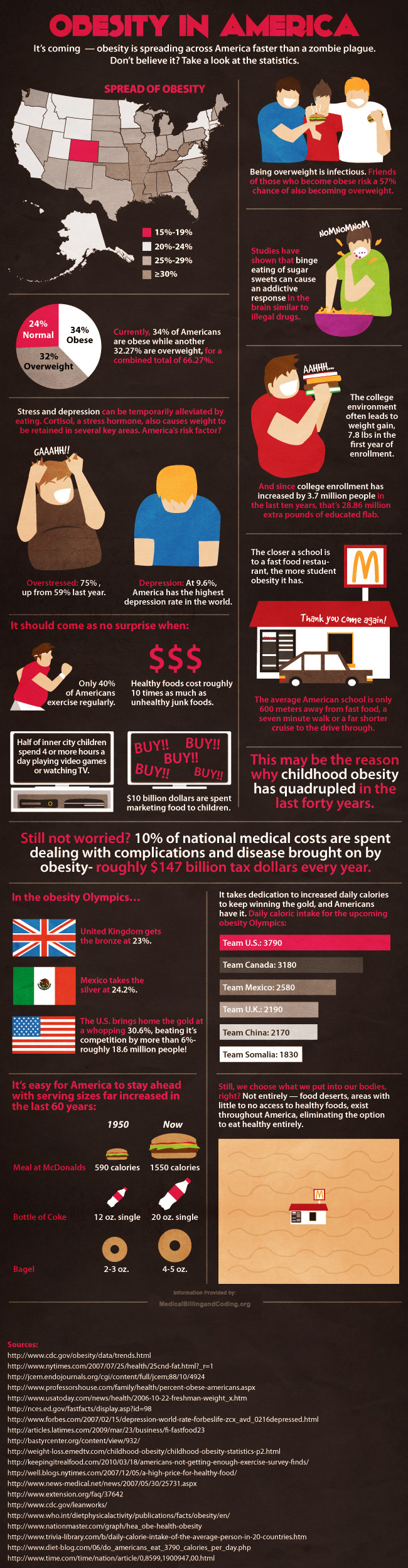
But what really causes obesity? Is “put down the fork” solid advice, or are there other underlying factors that need to be resolved before obesity can be conquered in the United States? Find out more about obesity in America here and discover some of the reasons we pack on extra pounds – and how to avoid them.
Conclusion
Your thoughts and comments on this ME-P are appreciated. Feel free to review our top-left column, and top-right sidebar materials, links, URLs and related websites, too. Then, subscribe to the ME-P. It is fast, free and secure.
Link: http://feeds.feedburner.com/HealthcareFinancialsthePostForcxos
Speaker: If you need a moderator or speaker for an upcoming event, Dr. David E. Marcinko; MBA – Publisher-in-Chief of the Medical Executive-Post – is available for seminar or speaking engagements. Contact: MarcinkoAdvisors@msn.com
OUR OTHER PRINT BOOKS AND RELATED INFORMATION SOURCES:
DICTIONARIES: http://www.springerpub.com/Search/marcinko
PHYSICIANS: www.MedicalBusinessAdvisors.com
PRACTICES: www.BusinessofMedicalPractice.com
HOSPITALS: http://www.crcpress.com/product/isbn/9781466558731
CLINICS: http://www.crcpress.com/product/isbn/9781439879900
BLOG: www.MedicalExecutivePost.com
FINANCE: Financial Planning for Physicians and Advisors
INSURANCE: Risk Management and Insurance Strategies for Physicians and Advisors



Share this:

Filed under: Alerts Sign-Up | Tagged: Infographics, Medical Billing and Coding, obesity |
 The Leading Business Education Network for Doctors, Financial Advisors and Health Industry Consultants
Medicare Now Pays for Intensive Obesity Counseling
CMS, which first floated the obesity coverage plan last September, said it expects more than 30% of the Medicare population to qualify for the new benefit.
Beneficiaries with body mass index values of 30 or more can receive weekly in-person intensive behavioral therapy visits for one month, followed by visits every two weeks for an additional five months, fully paid by Medicare with no co-payment.
Additional monthly sessions will be covered for up to six months afterward if the beneficiary has lost at least 6.6 pounds (3 kg) during the first six months. The sessions should also include dietary counseling, the agency said. Medicare patients who fail to lose the 6.6 pounds in six months may be re-evaluated at the one-year mark after the initial screening.
Those showing “readiness to change” and a BMI value still at 30 or more may receive another round of counseling paid by Medicare.
Source: Obesity (Issue 602) via Diabetes in Control [12/2/11]
LikeLike
Obese 8-year-old put in foster care
A third-grader who was considered severely obese was taken from his family and placed into foster care. The social workers said the boy’s mother wasn’t doing enough to help control his weight and now he is at risk for DM and HTN.
http://specials.msn.com/a-list/news/obese-8-year-old-put-in-foster-care
Susan
LikeLike
Obesity in America
The Institute of Medicine has released a new report, “Accelerating Progress in Obesity Prevention: Solving the Weight of the Nation“.
http://www.iom.edu/Reports/2012/Accelerating-Progress-in-Obesity-Prevention.aspx
Mike
LikeLike
Obesity – the new ATM for the health care system
The AMA’s board and delegates proceeded to snatch defeat from the jaws of victory by ignoring their own scientific council and just labeling obesity as a disease.
To be clear, the decision is almost purely symbolic; it has no legal force or authority, but it does up the ante in the debate with insurers and employers over what care elements should be covered and reimbursed.
In other words, it is about money.
Anonymous MD
LikeLike
Prevalence of Obesity, by Age Group, Among Adults Aged 20 and Over
United States, 2011-2012
Ages Obesity Rate
20-39 30.30%
40-59 39.50%
60+ 35.40%
All Adults, 20 and Over 34.90%
So, why do we need SNAP and food stamps?
Source: CDC/NCHS
LikeLike
Recent Key Trends and Statistics on Obesity
1. More than one-third (34.9%) of adults were obese in 2011–2012.
2. In 2011–2012, the prevalence of obesity was higher among middle-aged adults (39.5%) than among younger (30.3%) or older (35.4%) adults.
3. The overall prevalence of obesity did not differ between men and women in 2011–2012.
4. The prevalence of obesity among adults did not change between 2009–2010 and 2011–2012.
Source: CDC/National Center for Health Statistics
LikeLike
Health Care Costs by Body Mass Index
Body mass index (BMI) is a measurement of a person’s weight adjusted for his or her height, and can be used to screen for possible weight-related health problems. A healthy or normal BMI is 19-24, while overweight is 25-29 and obese is 30 and above. For example, a 5-foot-6-inch person who weighs 117.5 pounds has a BMI of 19, while a person of the same height weighing 279 pounds has a BMI of 45.
According to a study published in the journal Obesity, the average annual health care costs for a person with a BMI of 19 was found to be $2,368; this grew to $4,880 for a person with a BMI of 45 or greater.
Source: Duke Medicine
LikeLike